Heated beads art set
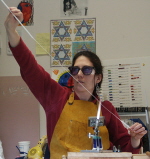 My goal is to create functional works of art out of glass and ceramic.
If it can withstand temperatures in excess of 1500 degrees minimum, then its the medium for ME. I only work hot. I am a glass and ceramic artist. I create one-of-a-kind lampwork glass beads, and fused glass, in my studio. In addition, I specializes in hand built and wheel thrown and altered Judaica pottery.
In my glass studio, I work with a blowtorch and use three types of glass: Moretti, Lauscha, and Vetrofond, to create lamp work glass beads. The process of creating lamp work beads involves many steps. First, I wind many colors of molten glass onto a stainless steel rod called a Mandrel. Then I balance the glass on the mandrel by constantly rotating the glass, and fighting the force of gravity. This process forms a round bead. Finally, I heat the beads in a kiln overnight, a process called annealing, to provide the beads with added strength and durability.
I also create fused glass pieces to be used in jewelry. I layer different colors and types of glass to get depth in my pieces. I enjoy the interaction with the kiln in creating these glass pieces. Every minute counts when fusing glass. If the glass over fires it will drip right out of the kiln. Fused pieces must be observed and when properly fused, the kiln is opened and "crashed". I deliberately drop the temperature of the kiln 500 degrees as a fast as possible, usually within two minutes.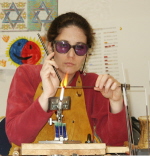 This keeps the glass from devitrifying or separating and getting a film over the top of the glass.
My pottery features many Jewish themes. My favorite works exemplify a unique Jerusalem theme symbolizing the ancient blocks of the Kotel. I utilize my Jerusalem theme, as well as other Judaica themes, on various functional, ritual pieces including Seder Plates, Menorahs, Washing Cups, Apple & Honey sets, Mezuzzot and Shabbat objects.
Now that you know what I do, here is a little tutorial of how I do it.
This is how I make a bead!!! Enjoy!
Step 1: Creating a Stringer
When beginning to create a Lampwork Bead, the glass rods must be prepared by melting and pulling long STRINGERS of glass (even thinner rods of glass). Stringers are like glass paintbrushes to be used for any detail placed in the bead. Some stringers are made by combining many different colors of glass into one stringer.
Step 2: Creating a base bead
Next, a rod of glass and a mandrel coated with bead release are heated. As the glass rod starts to melt, the mandrel is rotated to let the glass melt onto the mandrel evenly. The mandrel is kept continuously spinning to keep the glass from dripping off. After the base color is on the mandrel, it is time to start decorating the bead.
Related posts:
 This American flag is easy to make with kids and it s a fun way to use beads. It also makes a cute patriotic refrigerator magnet in honor of July 4th. My daughter…
 Last Wednesday, 8 teens showed up to make things out of Perler beads! Perler beads, generically known as fuse beads, are little different colored beads you arrange…
 What inspired you to launch Fashion Colorworks? I noticed that among the few bead competitions, there are no truly international contests accessible to artists around…
 Rated 3.7 out of 5 by 3 reviewers. Rated 5 out of 5 by jessabo Simple and elegant! I was decorating for an elegant bubbles and brews birthday party and I needed…
 The even, deep blue color of this lapis lazuli cabochon is rare and highly prized by connoisseurs. Lapis lazuli is treasured the world over for its beautiful deep…